
One of the biggest reasons homeowners put off finishing their basement isn't money — it's uncertainty. They're not sure how long it will take, what the process actually looks like, or what they'll be living through while it happens. Construction feels like a black box, and that uncertainty is uncomfortable. We think it doesn't have to be. Here's exactly how a basement renovation works at Building Concepts, from first conversation to finished space. Step 1: The Basement Vision Session Everything starts with a conversation — not a sales pitch. Our Basement Vision Session is a walkthrough of your space where we listen to how you want to use the basement, what matters most to you, and what your investment range looks like. We ask a lot of questions at this stage. What does your family actually need down there? Do you want a dedicated guest room, or is flexibility more important? Are you thinking wet bar, home office, kids' playroom — or some combination? Understanding your life first is how we design a space that actually works. At the end of this session, you'll have a clear sense of what's possible in your space and what a realistic project investment looks like. No pressure, no commitment required. Step 2: Design Once you decide to move forward, we get to work on the design. This is where your vision starts to take shape on paper — floor plans, layout options, material selections, and finish choices all come together here. We involve you in the decisions that matter and handle the ones that don't need to take up your mental bandwidth. The goal is a design you feel confident in before a single wall goes up — because changes are inexpensive on paper and expensive in the field. This phase typically takes two to four weeks, depending on the complexity of the project and how quickly decisions come together. Step 3: Permits and Pre-Construction Before any work begins, we pull all required permits with your local municipality. In Hamilton County and the surrounding Indianapolis suburbs, basement finishing projects almost always require permits for framing, electrical, plumbing, and HVAC work. We handle this entirely — you don't need to navigate the permit office. We also use this time to finalize your material orders and schedule our trade partners. Getting these logistics right upfront is what keeps projects on schedule once construction begins. Step 4: Construction This is the phase most people think of when they picture a renovation — and it's the one with the most moving parts. Here's how it typically unfolds: Framing comes first. Walls go up, rooms take shape, and you start to get a real sense of how the space will feel. This usually takes one to two weeks. Rough mechanicals follow — electrical, plumbing (if you're adding a bathroom or wet bar), and HVAC extensions are run through the framing before walls are closed. This is also when inspections happen. Insulation and drywall come next, and at this point the basement starts to feel like a real room rather than a construction site. Finish work is the final push — flooring, trim, paint, cabinetry, fixtures, and all the details that make a space feel intentional and complete. This phase takes the most time relative to the visible progress, but it's where craftsmanship really shows. A typical Building Concepts project runs eight to twelve weeks from construction start to completion, depending on scope. Step 5: Final Walkthrough and Handoff When the work is done, we walk through the finished space with you — not to hand you a punch list, but to make sure everything is exactly right. We want you to feel the same way at the end of the project that you did when you first imagined what this space could be. What It's Like to Live Through It Most homeowners tell us the process was easier than they expected. The basement is largely self-contained, so day-to-day life upstairs isn't significantly disrupted. There will be noise during certain phases, and tradespeople coming and going — but we keep the schedule predictable and communicate proactively so you're never left guessing what's happening or when. Ready to See What the Process Looks Like for Your Home? The best first step is a Basement Vision Session — a no-obligation conversation about your space, your goals, and what a finished basement could look like for your family. Book yours here and let's get started.
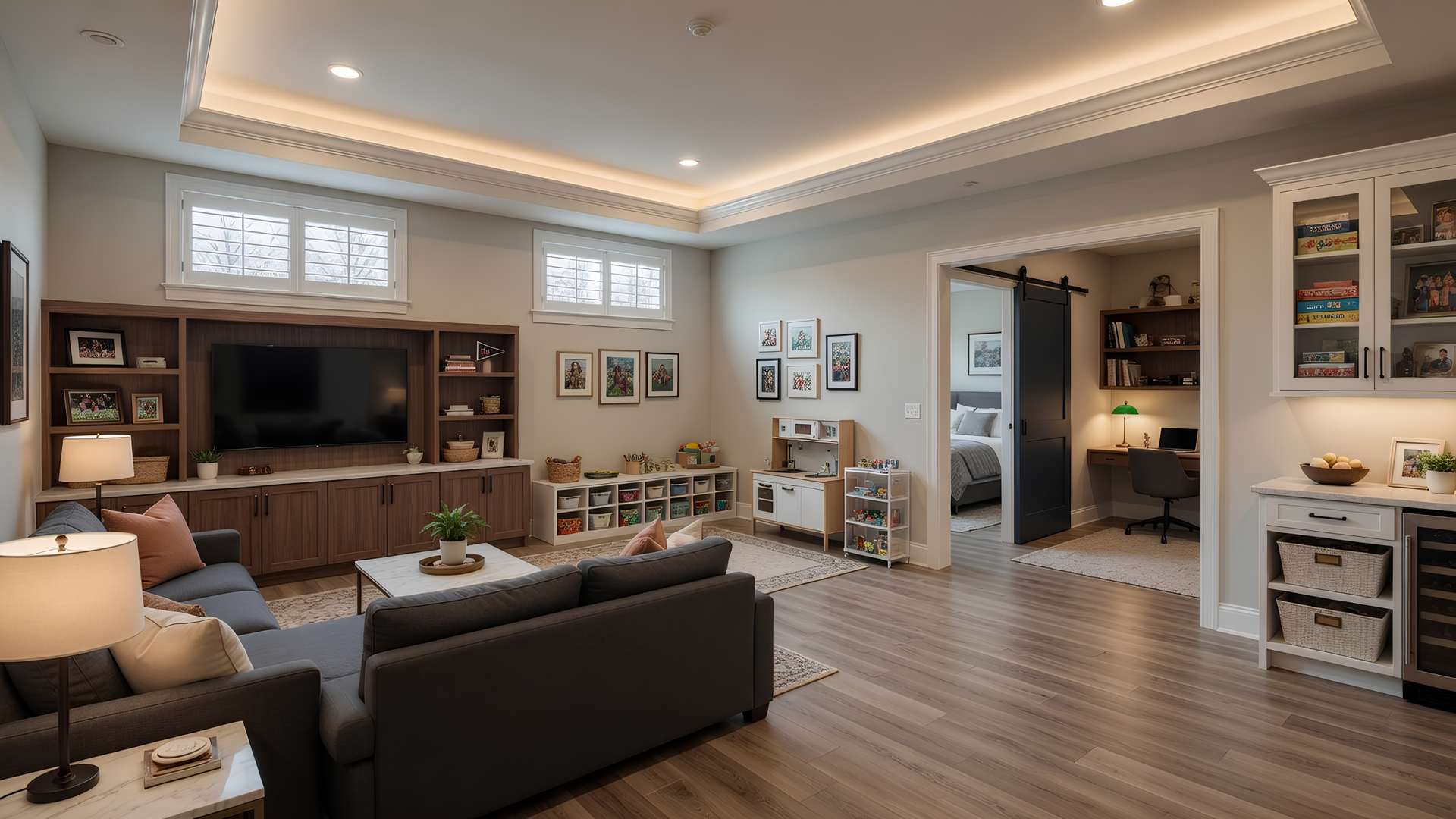
Most homeowners don't wake up one morning and decide to finish their basement out of nowhere. It's more of a slow build — a growing awareness that the space underneath the house is sitting there, empty, while the rest of the home feels a little too full, a little too loud, or a little too short on room. If you've been thinking about it for a while but haven't pulled the trigger, you're not alone. It's a meaningful investment, and the timing matters. Here are six signs that suggest you're ready — not just in theory, but in practice. 1. Your Family Has Outgrown the Main Floor This is the most common catalyst, and it tends to sneak up on you. The kids were small and the house felt fine. Then they got bigger, their stuff got bigger, and suddenly the living room is a toy storage facility and you haven't had a quiet evening in longer than you can remember. A finished basement doesn't just add square footage — it redistributes how your family uses the home. The main floor becomes the main floor again. Kids have a place that's genuinely theirs. Adults get their space back. The whole house breathes differently. If you're regularly feeling cramped on the main level, the answer is probably underneath your feet. 2. You Have Out-of-Town Family Who Visits Regularly There's a certain point in life when the air mattress situation stops being acceptable. If your parents, in-laws, or siblings visit more than once or twice a year — and especially if those visits last more than a night or two — a proper guest suite in the basement is one of the most relationship-preserving investments you can make. A real room with a real bed, a bathroom nearby, a door that closes, and actual privacy changes the dynamic of every visit. Guests stay longer because it's comfortable. You enjoy having them because you're not living on top of each other. It's one of those additions that pays dividends in ways that don't show up on a cost spreadsheet. 3. You're Working from Home — Permanently If remote or hybrid work is now a permanent part of your life and you're still working at the kitchen table, a corner of the bedroom, or a makeshift desk in a room that serves three other purposes, you already know this isn't sustainable. A dedicated home office in the basement changes your professional life in a way that's hard to overstate until you have it. The commute is a flight of stairs. The noise is gone. The door closes. Work stays at work, even when work is at home. If your career depends on focus and professionalism — and video calls that don't have chaos in the background — a finished basement office isn't a luxury. It's an infrastructure decision. 4. You've Stopped Going Down There This one's subtle but telling. If your unfinished basement has become a place you avoid — a dumping ground for storage, a space you open the door to and immediately close again — that's not just a wasted square footage problem. It's a symptom of potential. Finished basements get used. Constantly, daily, enthusiastically. They become the room people drift to, the space that gets mentioned when friends ask for a home tour, the place your kids want to spend Friday night instead of somewhere else. The gap between an unfinished basement and a finished one isn't just aesthetic — it's the difference between space you tolerate and space you love. 5. You're Planning to Stay in Your Home for Several More Years A basement finish is a long-term investment, and the longer you have to enjoy it before a potential sale, the better the return — in quality of life and financially. If you're planning to stay in your Carmel, Fishers, Westfield, or Noblesville home for five or more years, now is a sensible time to invest in the space. Waiting until you're ready to sell to finish the basement is one of the most common regrets we hear from homeowners. They get a return on the investment, but they never got to live in it. Start sooner, and you get both. 6. You Have a Specific Vision — Even a Partial One You don't need a fully formed plan to be ready to start. But if you find yourself thinking about what your basement could be — if you've saved a photo, described it to a spouse, or caught yourself mentally arranging furniture in a room that doesn't exist yet — that's a meaningful signal. The design process exists to take a partial vision and build it into something complete. You don't need to walk in with every decision made. You just need a starting point and a willingness to think it through with someone who does this every day. If Any of These Sound Familiar, You're Ready The best time to finish a basement is when the need is real and the timing is right. If more than one of the above resonates, both conditions are probably met. The next step is simple: a conversation about your space, your goals, and what's actually possible. No commitment, no pressure — just clarity. Book a Basement Vision Session and let's figure out what your lower level should become.

Choosing the right contractor for your basement is one of the most consequential decisions you'll make in the entire project. The design, the materials, the timeline — all of it flows through whoever you hire. Get it right and the experience is smooth, the result is something you're proud of, and the relationship feels collaborative. Get it wrong and you're dealing with delays, surprises, and a finished product that doesn't match what you were sold. The good news is that the right contractor isn't hard to identify — if you know what to ask. Here are seven questions worth putting to anyone you're seriously considering. 1. Do you specialize in basements, or is this one of many things you do? This question matters more than it might seem. A general contractor who does kitchens, additions, basements, and decks has divided expertise. A contractor who focuses specifically on basement finishing has seen every variation of every problem — moisture issues, awkward mechanical placements, challenging ceiling heights, unusual layouts — and knows how to handle them without billing you for the learning curve. Specialization also signals investment. A company that has built its entire reputation on basement renovations has more at stake in getting yours right than a generalist who moves on to the next job type after yours. 2. Are you licensed and insured in Indiana? This should be non-negotiable, and any legitimate contractor will confirm it without hesitation. Ask for their contractor's license number and certificate of insurance — general liability and workers' compensation both. If someone is reluctant to provide these, that tells you everything you need to know. Working with an unlicensed or uninsured contractor puts you at legal and financial risk if something goes wrong on your property. It also typically means their work won't pass inspection, which creates problems down the road when you go to sell. 3. Will you pull the permits? Permit-pulling is a reliable signal of a contractor's operating standards. Permits exist to ensure that framing, electrical, plumbing, and HVAC work are inspected and meet code. A contractor who suggests skipping them is cutting corners — either because their work doesn't pass inspection, or because they're trying to move faster than the process allows. In Hamilton County and the Indianapolis suburbs, unpermitted work can create real complications at resale. Buyers' lenders and inspectors catch it. A quality contractor handles permits as a standard part of the process, not as an optional add-on. 4. Can I see examples of completed basements — and talk to past clients? Photos show craft. References reveal character. Both matter. A contractor who's proud of their work will have a portfolio ready. Look for finished spaces that feel polished and intentional — consistent trim, well-integrated lighting, materials that feel cohesive rather than assembled from a catalog. A poorly photographed portfolio, or one with limited examples, is worth noting. References take it a step further. When you talk to past clients, ask not just whether they were happy with the result, but how communication was throughout the project. Did the contractor show up when they said they would? Were there surprises in the final cost? Would they hire them again? 5. What does your design process look like? A contractor who skips design — who shows up with a tape measure, gives you a number, and starts building — is skipping the part of the process where problems get caught before they're expensive. Design is where layout decisions are made, where material conflicts are identified, and where you get to change your mind for free. Look for a contractor who treats design as a genuine phase of the project, not a formality. The more thought that goes into the plan before construction begins, the smoother construction runs. 6. How do you handle changes or unexpected conditions? Every basement renovation involves some degree of the unknown — a beam in an inconvenient place, plumbing that's not where the builder's plan said it was, a moisture issue that becomes visible once walls come down. The question isn't whether surprises will happen; it's how they'll be handled. A trustworthy contractor will have a clear process for communicating unexpected conditions, presenting options, and getting your approval before proceeding. Vague answers here — "we'll figure it out," "it depends" — are a yellow flag. What you want is a contractor who can walk you through exactly how change orders work and what your rights are at every step. 7. What does the payment schedule look like? Be cautious of any contractor who asks for a large deposit upfront — more than 10–20% before work begins is unusual and worth questioning. A standard payment schedule ties disbursements to milestones: a deposit at signing, payments at framing completion, rough mechanicals, drywall, and final completion. This structure protects you and gives the contractor appropriate working capital. Never pay in full before the project is done. It eliminates your leverage and, in the worst cases, the contractor. The Honest Version of This List If you ask these seven questions and get clear, confident, unhesitating answers, you're probably talking to someone worth hiring. If any of the answers are vague, defensive, or dodged entirely, trust that instinct. The right contractor welcomes these questions. They've answered them before, and they know that clients who ask them are serious, informed, and worth working with. We're happy to answer every one of them. Book a Basement Vision Session and let's have an honest conversation about your project.

If you've been living with an unfinished basement and finally feel ready to do something about it, the first question you're probably asking is the same one nearly every homeowner asks: What's this going to cost me? It's a fair question — and an important one. The honest answer is that basement finishing costs in the Indianapolis area vary quite a bit depending on the size of the space, the features you want, and the level of finish you're after. But we can give you a realistic framework so you can plan with confidence. The Short Answer: What Homeowners in Central Indiana Are Spending For a finished basement in the Hamilton County and Indianapolis suburbs area, most homeowners are investing somewhere in this range: Entry-level finish (functional space, basic finishes): $50,000–$75,000 Mid-range finish (dedicated rooms, upgraded materials, wet bar or half bath): $75,000–$110,000 Premium finish (full bath, custom built-ins, home theater, high-end materials): $110,000–$150,000+ These numbers reflect 2026 labor and materials costs in the Central Indiana market. They also assume a full design-build process — not a piecemeal approach where you're coordinating multiple contractors yourself. What Drives the Cost of a Basement Finish? Understanding where the money goes helps you make smarter decisions about where to invest and where to pull back. Square Footage This one is straightforward: more space costs more. But the relationship isn't always linear. Certain fixed costs — permits, HVAC extensions, electrical panels — are relatively consistent regardless of size. A 1,200 sq. ft. basement doesn't cost twice as much as a 600 sq. ft. one. The Rooms You're Adding A basic open rec room is the most cost-efficient option. The moment you add rooms — a guest bedroom, a dedicated home office, a playroom with soundproofing — costs climb because of the framing, drywall, doors, and any electrical or HVAC work each space requires. A bathroom is typically one of the largest line items in any basement project. Adding a full bath can add $15,000–$25,000 depending on finishes and whether plumbing is already roughed in. A half bath runs less, but still represents a meaningful investment. Wet Bar or Full Kitchen Setup A well-designed wet bar is one of the most popular additions in our Hamilton County projects — and for good reason. It transforms a rec room into a true entertainment space. Budget $8,000–$20,000 depending on cabinetry, countertops, and appliances. Egress Windows If your basement doesn't have an egress window and you want to add a legal bedroom, you'll need one. Plan for $3,000–$6,000 per window, including the excavation and well. Flooring, Ceilings, and Finishes The materials you choose have a significant impact on the overall budget. Luxury vinyl plank flooring, for instance, is a popular choice — durable, moisture-resistant, and available in a wide range of styles. Carpet in bedroom spaces adds warmth. Exposed or drop ceilings are less expensive than drywall ceilings, but the difference in how a space feels is significant. Existing Conditions The state of your basement before work begins matters. Homes built by Lennar, Pulte, M/I Homes, and David Weekley — common throughout Carmel, Fishers, Westfield, and Noblesville — often have basements with rough-in plumbing already in place, which reduces cost. Older homes or those with drainage or moisture issues may require remediation work before finishing can begin. A Word on "Cheap" Estimates If you've gotten a quote that seems significantly lower than the ranges above, it's worth asking a few questions. Are permits included? Is the contractor properly licensed and insured? Are the materials specified — or will that be sorted out later? Unfinished basements that were finished on the cheap have a way of showing it within a few years: doors that don't close right, moisture issues that weren't addressed upfront, finishes that feel disconnected from the rest of the home. At Building Concepts, we see these situations regularly, and the cost to fix them almost always exceeds what a quality finish would have cost from the start. Is a Finished Basement Worth It? For most Central Indiana homeowners, yes — especially in a market where finished square footage is highly valued. A well-executed basement finish typically returns 70–75% of its cost in appraised home value, and in practice, it makes your home significantly more competitive when it comes time to sell. More than that, it gives your family usable space right now. Whether it becomes a place for the kids to play, a room for guests, a home office, or a space just for you — a finished basement changes how you live in your home every day. What Comes Next The best way to get an accurate number for your specific home is to walk through it with someone who does this every day. At Building Concepts, our Basement Vision Session is a no-pressure conversation designed to help you understand what's possible in your space and what a realistic investment looks like — before you commit to anything. Ready to put a real number to your project? Book a Basement Vision Session and let's talk through what your lower level could become.

Remote and hybrid work has permanently changed how homeowners think about their space. A dedicated home office used to be a nice-to-have. For a lot of families in Central Indiana, it's now a necessity — and the basement is one of the best places to put one. Done well, a basement home office is quiet, removed from household traffic, and genuinely productive. Done poorly, it's a dim, uninspiring room you dread sitting in. Here's what separates the two. What Makes a Basement Home Office Work Thoughtful Lighting This is the single most important factor — and the one most often underestimated. Basements don't have abundant natural light, so the artificial lighting plan has to work harder than anywhere else in the house. The worst outcome is a single overhead fixture that floods the space with flat, harsh light. A good basement office uses layered lighting: recessed ceiling lights for general illumination, task lighting at the desk, and ideally at least one window (or egress window) positioned to bring in as much natural light as possible. Warm-toned bulbs in the 2700–3000K range make a meaningful difference in how the space feels over an eight-hour workday. If adding or enlarging windows is on the table, a basement office is one of the best reasons to do it. A Door That Closes This sounds obvious, but it's worth saying directly: a home office needs to be enclosed. An open-plan area with a desk in the corner is a workspace. A room with a door is an office — one where you can take a call without the dog barking in the background, focus without being interrupted, and genuinely separate work from home life at the end of the day. The psychological benefit of a door you can close at 5pm is real and underrated. Proper Electrical Planning A home office puts meaningful demands on your electrical system. Plan for more outlets than you think you need — on every wall, not just behind the desk. Consider dedicated circuits for workstations if you're running power-hungry equipment. Build in ethernet runs even if you're primarily on Wi-Fi today; a wired connection is more reliable for video calls and large file transfers. USB outlets at the desk, USB-C where possible, and in-desk grommets for cable management all contribute to a workspace that feels intentional rather than improvised. Ceiling Height Not every basement is created equal when it comes to ceiling height. Most newer construction in Hamilton County — homes built by Lennar, Pulte, M/I Homes, and similar builders — has basements with eight- or nine-foot ceilings, which are very workable. Older homes sometimes have lower clearances that can feel constraining in a room you'll spend hours in each day. Ceiling height also affects your finish options. A drywall ceiling typically requires more clearance than a drop ceiling, and the difference in how the two feel is significant. In an office specifically, a drywall ceiling almost always reads as more polished and professional. Sound Management One of the genuine advantages of a basement office is natural sound separation from the rest of the house. You can reinforce this with insulation in the walls and ceiling — particularly the ceiling, which is the floor above. This keeps your calls private, reduces noise traveling upstairs, and makes the space feel more like a real office environment. If you'll be on video calls frequently, also think about the wall behind you. A thoughtfully finished wall — shiplap, built-in shelving, or even just a well-painted surface — looks far more professional on camera than bare drywall or exposed mechanicals. What Doesn't Work Skipping the egress window to save money . If you're spending most of your workday in a basement room, adequate emergency egress matters — both practically and psychologically. A room with no window can feel oppressive over time, regardless of how well it's lit. Putting the office next to the mechanical room . HVAC systems cycle on and off throughout the day. If your office shares a wall with the furnace and water heater, you'll notice it on every call. Thoughtful placement matters. Designing for how you work today only . Work arrangements change. A basement office that also functions as a flex space — with a closet, good finishes, and a layout that could serve a guest or another use — is a smarter long-term investment than one so purpose-built that it can't adapt. The Bottom Line A basement home office is one of the most practical investments a remote or hybrid worker can make in their home. It improves your daily quality of life, adds usable square footage, and — when done well — makes your home more valuable and versatile. The key is designing it deliberately rather than just carving out a corner. The details that make an office genuinely functional are worth getting right from the start. Thinking about adding a home office to your basement? Book a Basement Vision Session and let's design a workspace that actually works for how you work.

Permits and building code aren't the most glamorous part of a basement renovation conversation — but they're among the most important. Understanding what's required before you start, and why those requirements exist, saves you from surprises mid-project and protects your investment for the long term. Here's a plain-language breakdown of what Indiana homeowners typically need to know. Why Permits Are Required — and Why They're Worth It When a basement finishing project involves structural work, electrical, plumbing, or HVAC, a permit is required. This isn't bureaucratic red tape for its own sake. Permits trigger inspections, and inspections exist to verify that the work meets code — meaning it was done safely, correctly, and in a way that won't create problems for the next owner of your home. Unpermitted work creates real risk. If work is done without permits and later discovered — during a home inspection at sale, for instance, or after an insurance claim — you may be required to open walls, redo work to code, and pay additional fees. The cost and inconvenience of that scenario almost always exceeds whatever was saved by skipping the permit process in the first place. In Hamilton County and the surrounding Indianapolis suburbs, basement projects are routinely inspected. A reputable contractor pulls permits as a matter of course and schedules inspections at the appropriate stages. If a contractor ever suggests skipping permits to save time or money, that's a significant red flag. What Typically Requires a Permit in Indiana While specific requirements vary by municipality, most basement finishing projects in Central Indiana will require permits for some or all of the following: Framing . Any new walls being built require a framing permit. Inspectors verify that load-bearing considerations have been addressed, that fire-blocking is correctly installed, and that the structure meets code. Electrical . New circuits, panel work, and outlet installations are inspected to ensure they meet National Electrical Code (NEC) standards. This is one of the most important inspections — electrical work done incorrectly is a fire hazard. Plumbing . If you're adding a bathroom, wet bar, or any new fixture that ties into your home's water supply or drain system, a plumbing permit is required. Inspectors verify that connections are correct, that proper venting is in place, and that there's no risk of backflow or contamination. HVAC . Extending your existing heating and cooling system into the finished basement — adding ducts, registers, or returns — requires a mechanical permit. Inspectors verify that the system is properly balanced and that combustion appliances have adequate combustion air. Egress Windows: The Most Misunderstood Requirement Of all the code requirements that come up in basement finishing, egress windows generate the most questions — and the most confusion. Here's what you actually need to know. An egress window is required for any room used as a sleeping room . This is a life-safety requirement: in the event of a fire, occupants need a viable escape route that doesn't require passing through a burning structure. A window that meets egress requirements provides that. In Indiana, the 2020 Residential Code (IRC) specifies that egress windows must meet minimum size requirements — a net clear opening of at least 5.7 square feet, with minimum height of 24 inches and minimum width of 20 inches. The sill height from the floor cannot exceed 44 inches. Window wells, if required, must be large enough to allow the window to fully open and for a person to escape. What this means practically : If your basement plan includes a bedroom or guest room, it needs an egress window. If existing windows don't meet the requirements, a new one will need to be cut and installed — a process that involves excavating alongside the foundation, cutting through the concrete, installing the window and well, and waterproofing the opening. It's a meaningful addition to the project scope, typically running $3,000–$6,000 per window, but it's non-negotiable for a sleeping room and worth every dollar from a safety standpoint. What about non-sleeping rooms? A home office, rec room, or media room used strictly for its intended purpose doesn't require an egress window — though adding one is never a bad idea for light, air circulation, and future flexibility. A Note on Ceiling Height Indiana's residential code requires a minimum finished ceiling height of 7 feet in habitable spaces. Basements in newer construction throughout Hamilton County typically have 8–9 foot poured walls, which gives you comfortable clearance after accounting for floor and ceiling assemblies. Older homes may be tighter, and this is worth confirming before finalizing your design. Beams, ducts, and mechanical runs that drop below the 7-foot minimum are allowed in specific circumstances — hallways and bathrooms, for instance, have different minimums — but your contractor should flag any areas where clearance may be an issue before framing begins. The Right Contractor Makes This Simple Navigating permits and code requirements is part of what you're paying a qualified contractor to do. At Building Concepts, we handle the permit process entirely — submitting applications, coordinating inspections, and ensuring every phase of work is approved before moving forward. You don't need to become an expert in municipal code. You just need a contractor who already is. Have questions about what your specific basement project will require? Book a Basement Vision Session and we'll walk through the details together.
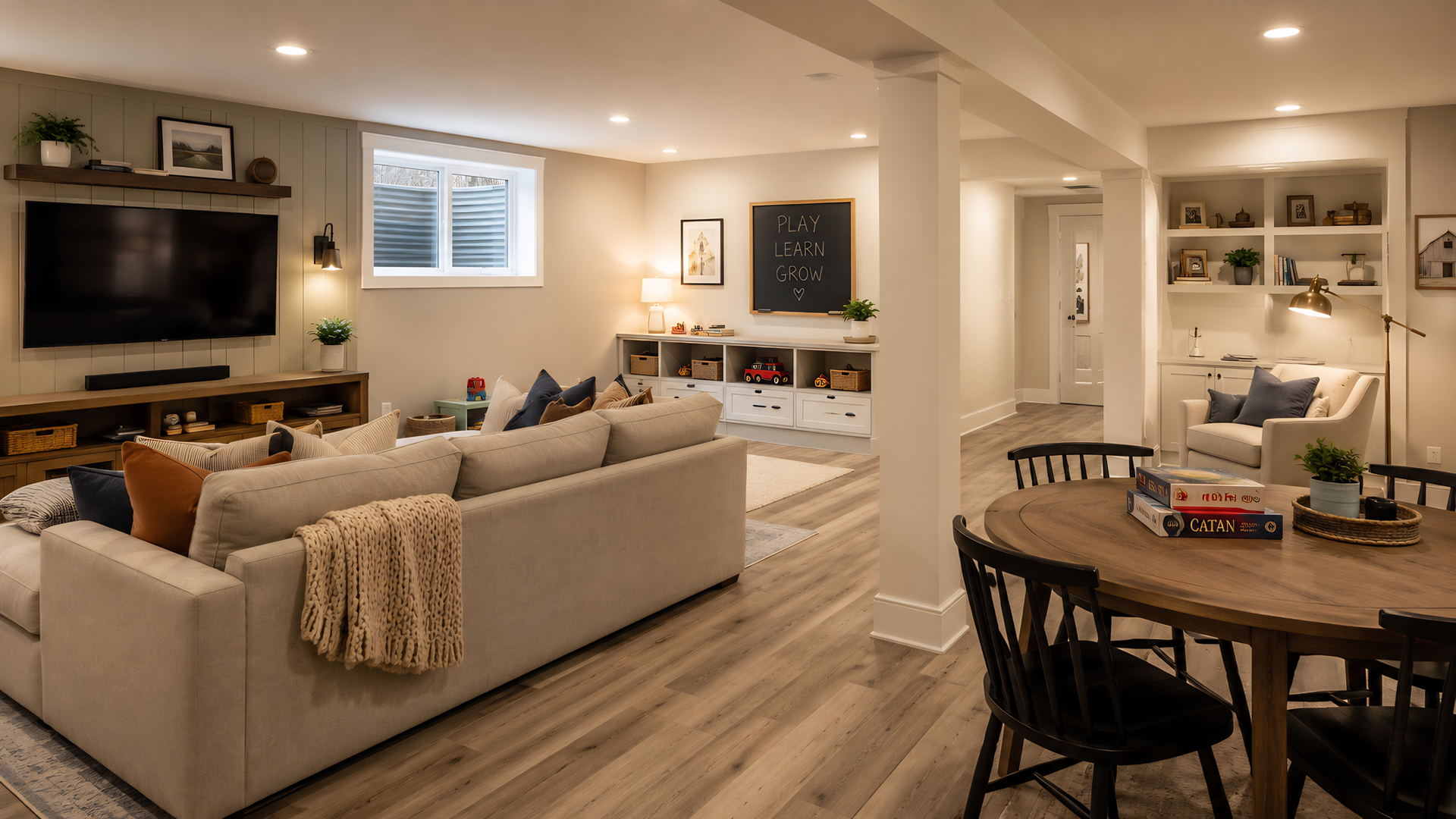
The most common question we hear after "how much does it cost?" is one that sounds simple but actually takes some thought: What should we do with the space? It's a good problem to have. An unfinished basement is essentially a blank slate — which means you can design it around exactly how your family lives, rather than adapting your life to a space that already exists. But that openness can also feel a little paralyzing if you're not sure where to start. Here are some of the most popular directions families in Central Indiana choose, along with the questions worth asking before you commit to one. The Family Rec Room The open rec room is the most versatile choice — and the most popular. Done well, it becomes the gravitational center of the home: the place where everyone lands on a Friday night, where kids bring their friends, where you actually want to spend time. A great rec room isn't just open floor space. It's designed with zones in mind — a seating area anchored by a TV wall, a game area (pool table, foosball, ping pong), maybe a wet bar along one wall for the adults. The key is making sure the layout supports how the space will actually be used rather than just filling square footage. Best for : Families with kids of any age, households that entertain, homeowners who want maximum flexibility. The Dedicated Kids' Playroom If you have young children, a dedicated playroom downstairs can genuinely change the way your main floor feels. Toys stay contained. The living room stays livable. Kids have a space that's truly theirs, and you have yours. The best playroom designs think ahead. Durable, easy-to-clean flooring (luxury vinyl plank holds up beautifully). Built-in storage that actually gets used — cubbies, shelving, cabinets at kid height. Bright, even lighting. And enough wall space for a chalkboard or whiteboard that doubles as décor and entertainment. Worth noting : kids grow up. A playroom that's designed with flexibility in mind — good bones, adaptable layout, quality finishes — can evolve into a homework room, a teen hangout, or a home gym as your family changes. Think about who your kids will be in ten years, not just today. Best for : Families with young children, parents who want to reclaim the main floor. The Guest Suite A finished basement guest suite is a genuine luxury — and one that gets used more than most people expect once it exists. Visiting family stays longer and more comfortably. You stop apologizing for the air mattress situation. A proper guest suite typically includes a bedroom with egress window (required by code for any sleeping room), a full or three-quarter bath, and ideally a small sitting area or at least a comfortable chair and good lighting. Thoughtful details — a closet with actual hangers, bedside outlets, a door that closes for privacy — are what separate a guest room from a place to crash. One thing to keep in mind: if your basement doesn't already have egress windows, adding them is an additional cost. But for a sleeping room, it's non-negotiable from a safety and code standpoint — and worth it. Best for : Families with out-of-town guests, multigenerational households, homeowners who want resale flexibility. The Flex Space More and more families are moving away from single-use rooms in favor of spaces that can adapt over time. A flex basement might include a main open area for family use, a smaller enclosed room that functions as an office now and a bedroom later, and a bathroom that makes both uses practical. Flex design requires a little more intentional planning upfront — but it pays off in longevity. The space works for your family now and continues to work as your needs shift, without requiring a renovation down the road. Best for : Growing families, homeowners who value adaptability, anyone who's not quite sure what they'll need in five years. A Note on Combinations The honest truth is that most finished basements aren't single-use spaces. They're combinations — a rec area that flows into a wet bar, a playroom tucked behind a partial wall, a guest room off to the side. The best designs integrate multiple functions in a way that feels intentional rather than compartmentalized. That integration is exactly what good basement design is about: creating a space that feels like a natural extension of the home above it, not a collection of separate rooms crammed into a lower level. Not Sure What's Right for Your Family? That's what the design process is for. At Building Concepts, we start every project by understanding how you actually live — then work backward to a layout that supports it. Book a Basement Vision Session and let's figure out what your lower level should become.
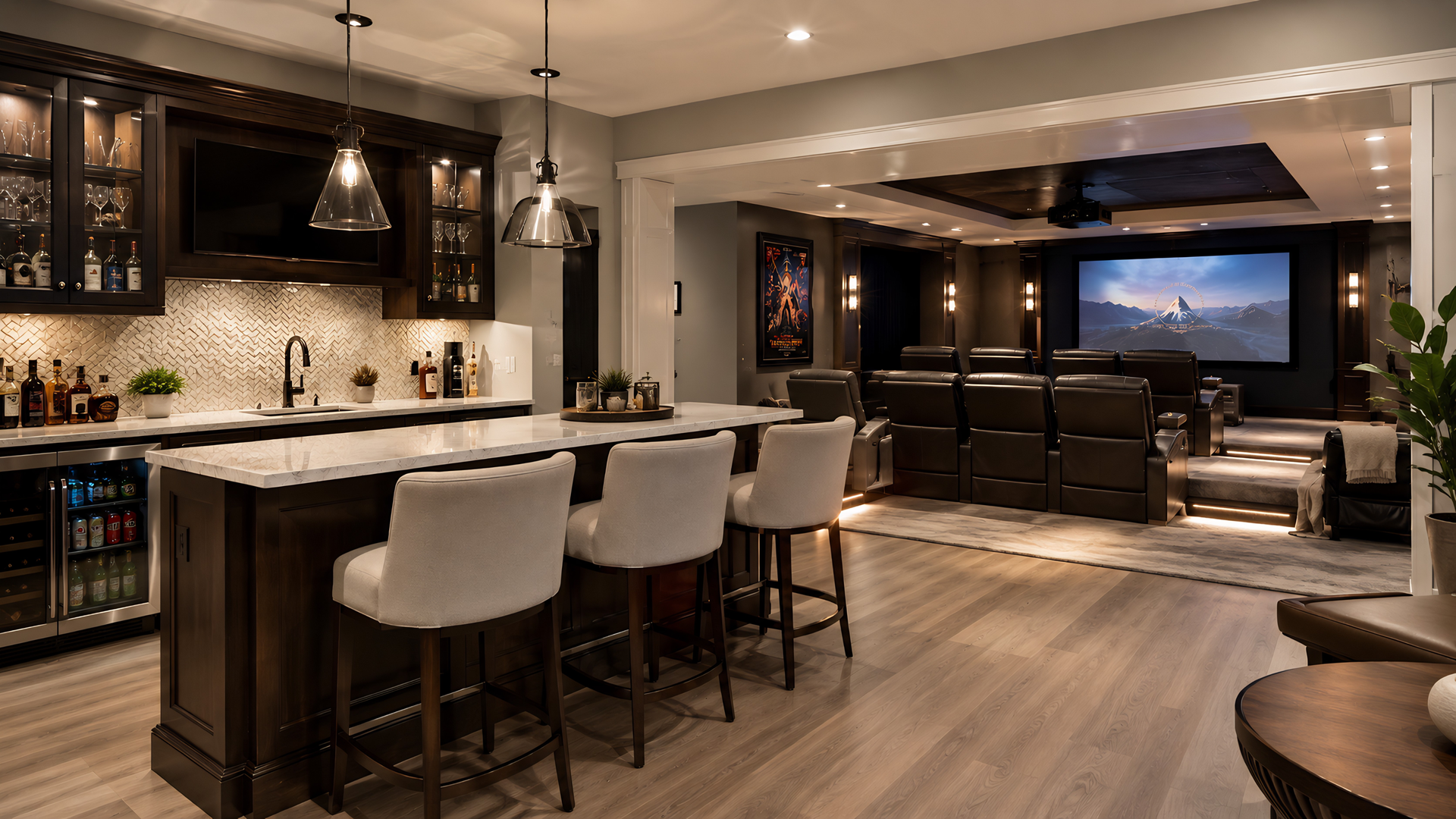
When homeowners start imagining their finished basement, two features come up more than almost anything else: a bar and a media room. Both are popular. Both transform a space. And both require enough investment that you want to get the decision right before construction begins. If you're trying to choose between the two — or figuring out whether you can have both — here's a practical framework for thinking it through.
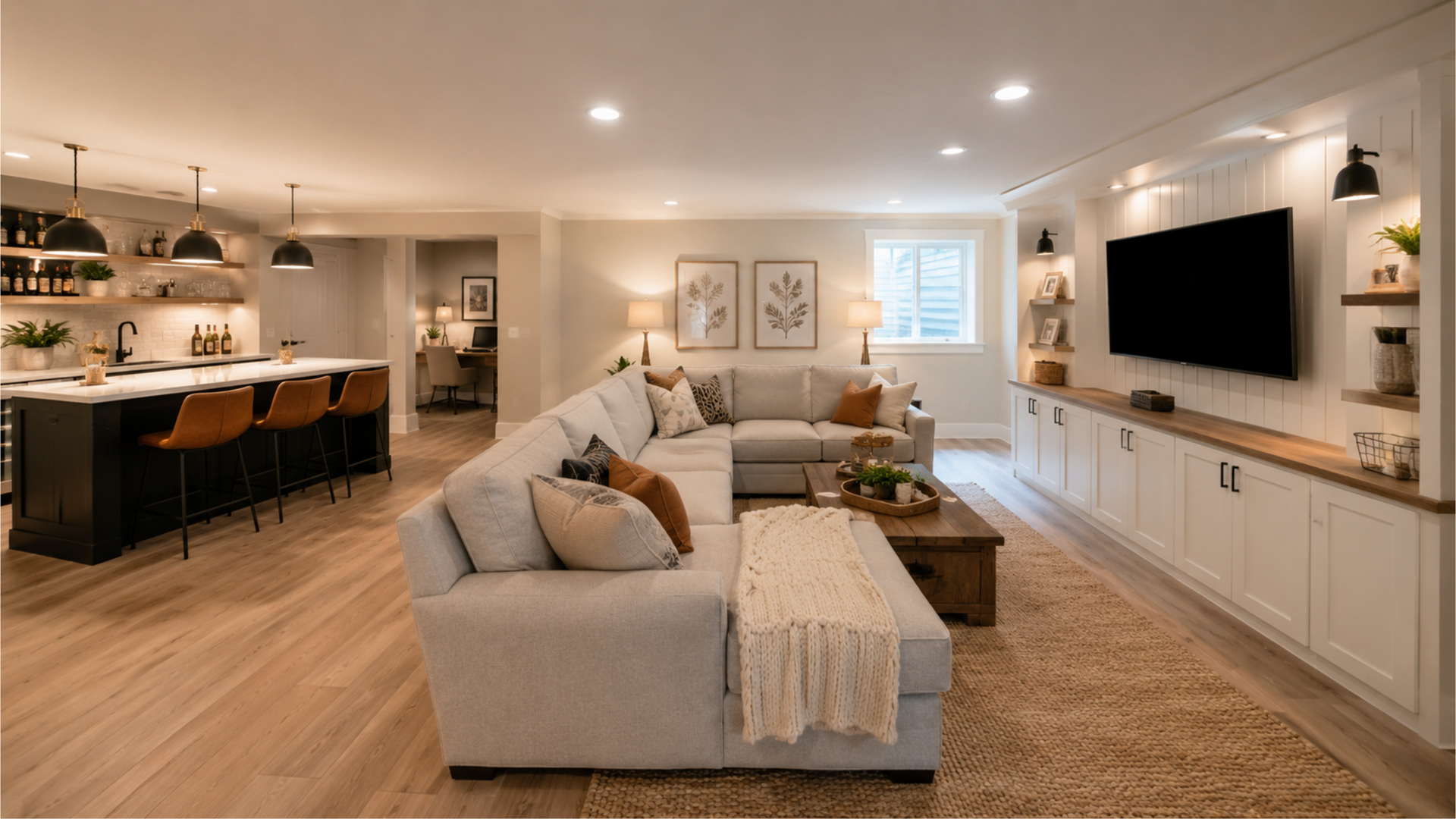
When homeowners in Hamilton County invest in a basement finish, they're usually thinking about how they'll use the space — the family room, the guest suite, the bar they've always wanted. But there's a parallel conversation worth having: what does this do for the value of my home? The short answer is quite a bit. A well-executed basement finish is one of the highest-return renovations available to homeowners in the Indianapolis suburbs — and in a competitive real estate market, it can be the difference between a home that moves quickly and one that sits. Here are five specific ways a finished basement adds value to your home.